What the VoterBase Update Means for 2026 Campaigns
Last week, TargetSmart released the largest demographic data update in the history of VoterBase, enriching 38.4 million voter records and re-verifying 232.7 million registered voters nationwide, with the strongest gains landing among younger voters, voters of color, and urban communities. Read the full breakdown here. That update laid the groundwork. The question for campaigns now is what it means heading into the 2026 midterms, and nowhere is the answer more consequential than in the fight for the Senate.
Targeted Senate Races
| Targeted states | 9 |
| Lift, all voters | +16.4% |
| Lift, voters of color | +19.8% |
| Highest all-voter lift | Alaska, +21.7% |
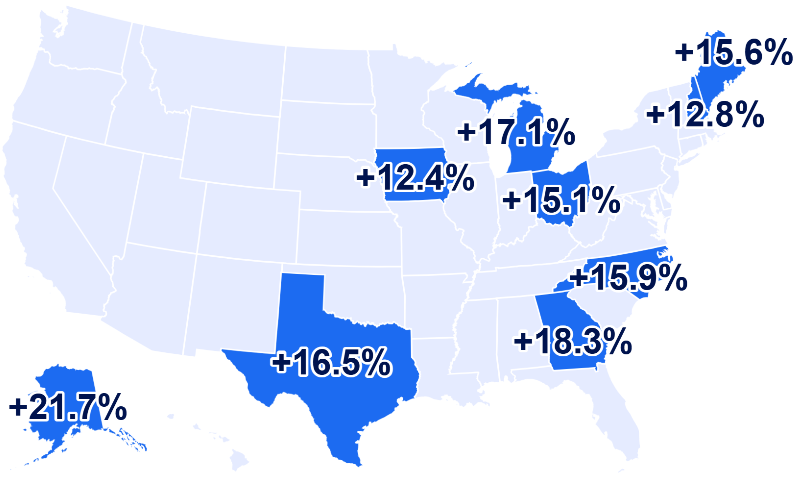
The 2026 Senate map will be won or lost in a handful of battleground states, decided by voters Democrats have historically struggled to reach effectively. Across nine targeted states, Alaska, Georgia, Iowa, Maine, Michigan, New Hampshire, North Carolina, Ohio, and Texas, the updated file shows a +16.4% lift across all registered voters and a +19.8% lift among voters of color.
Campaigns entering competitive statewide contests in these states will be building their targeting on notably firmer ground, translating into sharper universes, more complete outreach plans, and stronger voter contact in exactly the communities most likely to determine the outcome.
Closing the Gap with 2024 Non-Voters
2024 made clear where campaigns were losing ground, and this update closes that gap directly. Registrants who did not vote in 2024 updated at +22% nationally and +22.9% in swing states, compared with +14.3% nationally and +13.9% in swing states for those who did vote. In other words, the file is improving fastest among the people campaigns most often struggle to bring into the electorate in the first place. Heading into 2026, that gap gives campaigns a strategic opening they can act on right away.
What This Means for 2026 Campaigns
For 2026 campaigns, the takeaway is straightforward: this update functions less like routine file maintenance and more like an upgrade to the core work campaigns do every day, in three specific ways.
Cleaner contact universes. Additional data expands targeting across every direct voter contact channel, including field, mail, phone, text, and digital.
Sharper persuasion and turnout models. Updated consumer attributes feed directly into the modeled scores used to build universes this cycle, creating larger and more accurate audiences.
Prioritize where the lift is. The strongest data gains are among younger voters, voters of color, and urban precincts, all key to a Democratic victory.
What the VoterBase Update Means for 2026 Campaigns
Last week, TargetSmart released the largest demographic data update in the history of VoterBase, enriching 38.4 million voter records and re-verifying 232.7 million registered voters nationwide, with the strongest gains landing among younger voters, voters of color, and urban communities. Read the full breakdown here. That update laid the groundwork. The question for campaigns now is what it means heading into the 2026 midterms, and nowhere is the answer more consequential than in the fight for the Senate.
Targeted Senate Races
| Targeted states | 9 |
| Lift, all voters | +16.4% |
| Lift, voters of color | +19.8% |
| Highest all-voter lift | Alaska, +21.7% |
The 2026 Senate map will be won or lost in a handful of battleground states, decided by voters Democrats have historically struggled to reach effectively. Across nine targeted states, Alaska, Georgia, Iowa, Maine, Michigan, New Hampshire, North Carolina, Ohio, and Texas, the updated file shows a +16.4% lift across all registered voters and a +19.8% lift among voters of color.
Campaigns entering competitive statewide contests in these states will be building their targeting on notably firmer ground, translating into sharper universes, more complete outreach plans, and stronger voter contact in exactly the communities most likely to determine the outcome.
Closing the Gap with 2024 Non-Voters
2024 made clear where campaigns were losing ground, and this update closes that gap directly. Registrants who did not vote in 2024 updated at +22% nationally and +22.9% in swing states, compared with +14.3% nationally and +13.9% in swing states for those who did vote. In other words, the file is improving fastest among the people campaigns most often struggle to bring into the electorate in the first place. Heading into 2026, that gap gives campaigns a strategic opening they can act on right away.
What This Means for 2026 Campaigns
For 2026 campaigns, the takeaway is straightforward: this update functions less like routine file maintenance and more like an upgrade to the core work campaigns do every day, in three specific ways.
Cleaner contact universes. Additional data expands targeting across every direct voter contact channel, including field, mail, phone, text, and digital.
Sharper persuasion and turnout models. Updated consumer attributes feed directly into the modeled scores used to build universes this cycle, creating larger and more accurate audiences.
Prioritize where the lift is. The strongest data gains are among younger voters, voters of color, and urban precincts, all key to a Democratic victory.